Saturday, January 07, 2017
Rewriting Fashion History
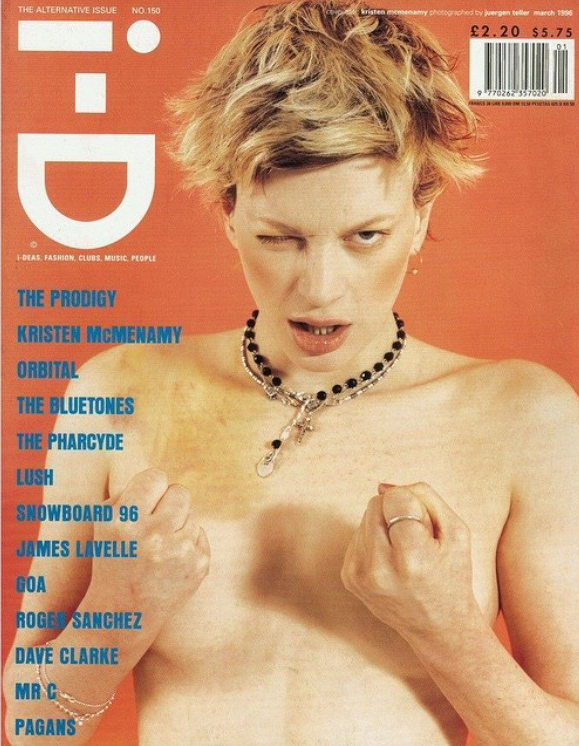
Way back in the 1990s I was the makeup artist on a shoot for ID magazine with the photographer Juergan Teller - our model was Kristen McMenamy. This is the cover and one of the other images that we produced.
Makeup artists and hairdressers were not paid by ID, we did it purely for credits. These images have become fashion famous and have been reused loads of times in other magazines and books but the hair and makeup artist have never been credited in these subsequent uses. Today I listened to an interview with Kristen McMenemy on the Showstudio site where she talks about her collaboration with Juergan and how she came to she draw the Versace heart on her chest. She did not mention the other 'collaborators' on the shoot. She is probably misremembering but to redress the record I would like to state that I was the makeup artist and that handwriting is mine. I am not disputing the collaborative nature of the Versace idea and the genius of the photographer but it would be nice to get the credit for my unpaid work.
Tuesday, January 19, 2016
Cut me beautiful
I have been thinking about the nuances in how cosmetic surgery is reported and perceived. Helen Mirren and Julie Christie are reported as having had good surgery - it doesn't change them too much, just helps them age gracefully. The main work they have (apparently) had is jaw work or a lower facelift - this means that they don't have to live with unsightly jowls. There are recommendation for more stuff they could do but they are generally looking good for their age.
'Bad' cosmetic surgery goes too far and it creates a look that could never be natural. 81 year-old Kim Novak, for instance, was derided for her strange new look with 'plumped up cheeks, stretched lips and high brows', when she presented an award at the 2014 Oscars.
So in effect we are applauding the falsifying nature of 'natural' surgeries while denigrating the honest artifice of the unnatural, 'too much', surgeries.
I recommend the 'You Must remember This' podcast generally for anyone interested in Hollywood stars, but specifically, in relation to what I have discussed, the episode on Kim Novak is very good.
'Bad' cosmetic surgery goes too far and it creates a look that could never be natural. 81 year-old Kim Novak, for instance, was derided for her strange new look with 'plumped up cheeks, stretched lips and high brows', when she presented an award at the 2014 Oscars.
So in effect we are applauding the falsifying nature of 'natural' surgeries while denigrating the honest artifice of the unnatural, 'too much', surgeries.
![]() |
| Helen Mirren and Julie Christie |
I recommend the 'You Must remember This' podcast generally for anyone interested in Hollywood stars, but specifically, in relation to what I have discussed, the episode on Kim Novak is very good.
![]() |
| Kim Novak |
Thursday, September 24, 2015
American Tan: transcript of an artist's talk
Dolph
47c Streatham Hill, London SW2
The following text is taken from the notes I made for a talk that I delivered alongside my show American Tan.
Film Diary is an ongoing series of work whereby I paint an image from every film I watch. The film watching is as important as the film itself and there are numerous factors which come together to make the paintings, which I show in groups of twelve.
It seems ironic the most enduring American film star - Marilyn Monroe - has little association with the healthy idea of American tan and is instead all about whiteness. In a series of work from 2012 called I'm a Girl not a Ghoul, I looked at how her personality was consumed by this whiteness.
There are so many Marilyn biographies, with more still being written. Sarah Churchwell has written a study of the biographies called The Many Lives of Marilyn Monroe which dispels many of the myths. One of the many biographers Fred Lawrence Guiles said 'White as worn by Norma Jeane was symbolic, white represents virtue and innocence.' [2]. Film theorist Richard Dyer notes that in many of Marilyn’s films the conventions of glamour lighting ‘make her disappear as flesh and blood.’[3] Marilyn is characterised by white and actually dyed her hair whiter as her career progressed – possibly in emulation of her own favourite star Jean Harlow.
My favourite Marilyn biography is the fictional Blonde by Joyce Carol Oates (a book denigrated by Churchwell). Oates’ version of Marilyn’s second husband, the playwright Arthur Miller, is perplexed by TS Eliot’s line: ‘Nothing is more dramatic than a ghost’ and is troubled by Marilyn’s fixation on the holocaust, calling it ghoulish. Marilyn repeats to herself over and over ‘I’m a girl not a ghoul.’ As if she is trying to fix herself in the way an analogue photograph is fixed by chemicals. Dyer says that: ‘White women are constructed as the apotheosis of desirability, all that a man could want, yet nothing that can be had, nor anything that a woman can be.’ [4]
The surface appearance of things is fascinating to me and Hollywood has been the master image maker. Laura Mulvey -in her 1996 essay 'Pandora's Box' said: ‘The cinema has enhanced the image of female seductiveness as a surface that conceals’
Lots of my recent work has involved the use of shiny surfaces – mirrors, iridescent paint, glass. These decorative surfaces are often trivialised and often associated with women. Gams features a series of femme fatale legs, reflected and re-reflected in mirrors.
Iris (Albert Maysles, 2015) is a document about octogenarian Iris Apfel whose has made herself a work of art through the way she dresses. She says: ‘with me its not intellectual, its all gut.’
Iris was reviewed on Radio 4's Saturday Review on 1 August 2015 and the three reviewers did not rate it very highly. Sebastian Faulks demeaned Iris and her radical fashion saying: ‘Basically this is a film about a very old woman who spends her life wearing very brightly coloured clothes and bangles… the disappointment is that despite her lovely voice she really doesn’t have anything interesting to say.’ Robert Hanks added: ‘Any film that is about fashion and doesn’t mention the fact that you are exploiting young girls and obsessed with youth and money is telling a kind of lie… I kept thinking it was going to be about something more – immigration, age – but it didn’t turn out to be about any of these things.’ This is because the film was about a woman who had spent her life immersed in dressing her body and the film was admirable because this is exactly what it focussed on.
In American Tan I have installed a wall of mirrors and found portraits. The picture mirrors particularly interest me - they reflect the person looking into them over an image of a star so they blend the self with the object of desire. They are pretty ineffectual as useful mirrors - they are purely decorative. Mirrors are symbols of self obsession - just as fashion is on one level about self obsession – the self as art object. The mirrors have a kitsch association.
The Menil Collection in Houston, Texas, is one of those amazingly vast private collections put together by a rich family with a philanthropic idea of educating people. The Byzantine Fresco Chapel – a modern concrete building designed by the Menil’s architect son, was built in 1997 to house a rescued Byzantine fresco from Cyprus. Sadly for them the fresco had to be returned to Cyprus in 2012 and the structure lay empty. It is now however being used to show contemporary art. The current exhibit is Janet Cardiff & George Bures Miller’s The Infinity Machine. A rotating mobile made up of 150 found mirrors in a dark space accompanied by a space soundtrack. Reflecting each other ad infinitum the artists talk about the generations of people that have been reflected in the mirrored. They are elevated from functional, or vanity objects into poignant signifiers.
It occurs to me that we are all constrained/subject to fashion to some extent – even the style we decide to paint in – we are subject to the power of advertising / marketing / fashion.
Mad Men is one of my favourite TV series – It is beautiful, stylish and seductive but features all the cutting terribleness of America’s mid-century and continuing problems – racism, sexism, corruption etc alongside the power of advertising with its ability to sell us anything.
I like many others have been seduced by an idea of America drawn in by marketing, cinema, popular culture etc. To accompany America Tan I wanted to show some of the beauty and power of this with a series of Dream America films that cover the last eight decades.
I am showing a different film each day of the show and today’s film has been Roustabout (Rich, 1964) and I will end with a brief paragraph from the screen notes I have put together for the films.
Roustabout
Elvis’ film contract stipulated that he, rather than a stunt double, must be allowed to ride motorbikes and drive cars in his films. In Roustabout he goes down the Wild One (Benedek, 1953), motorbike route. Misunderstood and disaffected he runs into Barabara Stanwyck and ends up romancing her stepdaughter and saving the carnival by singing.
[1] Richard Dyer, Heavenly Bodies (Routledge, 2003) pg 5
23 September 2015
The following text is taken from the notes I made for a talk that I delivered alongside my show American Tan.
![]() |
| American Tan talk at Dolph. Photo Tash Kahn |
I am interested in play acting, disguise, masquerading - and how we can enter other worlds through film, books, music, dressing up. This relates to my fascination around the blurring of fact and fiction – creating one’s own version of things – picking and choosing from history and culture – the unimportance of fact – creating our own narratives by combining pop culture with our own experience.
![]() |
| Film Diary #37 (13.10.12-24.10.12), 2014, oil on paper, 12x(23x30.5cm) |
Film Diary is an ongoing series of work whereby I paint an image from every film I watch. The film watching is as important as the film itself and there are numerous factors which come together to make the paintings, which I show in groups of twelve.
One of my other interests is why it is that certain people demand our attention – which raises the thorny matter of trying to define charisma. Alongside this I am fascinated by how it feels to be a fan – how you can feel something for someone you have never known and what it actual feels like to be one of these adored people – how their public and private personas become blurred.
This brings me to the title of the show - American Tan
In the catalogue for the 2002 exhibition Dear Painter Paint me… : Painting the figure since late Picabia the opening essay by Alison M Gingeras is called ‘Learning from Kippenberger: Figurative painting as provocative and sincere, critical and sentimental’ Here is a short extract
The title American Tan came to me because I was thinking about the commodification of women, particularly in Hollywood, and the way that stars during Hollywood’s Golden Age and through into the late 20th century became products to be marketed. Stars are, as Richard Dyer points out, ‘made for profit’[1] As viewers / consumers we imagine them living amazing glamorous lives – while in actuality they often struggle.
American tan is also a shade of tights sold in the UK. I have no evidence of the history of the name but anecdotally it seems to be a UK rather than US thing - it was presumably introduced post WW2 when America was seen as the most glamorous nation - and pasty UK women wanted to have the type of skin colour that they imagined Hollywood stars had. American tan seems to be obsolete now as a colour we want to apply to our legs and is more often associated with an unattractive slightly orangery, fake tan mimicking shade of tights.
This brings me to the title of the show - American Tan
In the catalogue for the 2002 exhibition Dear Painter Paint me… : Painting the figure since late Picabia the opening essay by Alison M Gingeras is called ‘Learning from Kippenberger: Figurative painting as provocative and sincere, critical and sentimental’ Here is a short extract
Lesson One: A good title is everything
Giving a title is always a delicate affair, especially in the domain of art. While the ubiquitous and delightfully neutral “untitled” offers an easy escape route for the naming of an individual artwork, it is not an option for the titling of an exhibition. A good title should encapsulate a complex set of ideas succinctly; it should be witty without being a one-liner; it should be conceptually compelling, but readily legible. And when finding a new, original title seems impossible, some creative thievery may be in order.
![]() |
| American Tan, 2015, oil on canvas, 102x153cm |
The title American Tan came to me because I was thinking about the commodification of women, particularly in Hollywood, and the way that stars during Hollywood’s Golden Age and through into the late 20th century became products to be marketed. Stars are, as Richard Dyer points out, ‘made for profit’[1] As viewers / consumers we imagine them living amazing glamorous lives – while in actuality they often struggle.
American tan is also a shade of tights sold in the UK. I have no evidence of the history of the name but anecdotally it seems to be a UK rather than US thing - it was presumably introduced post WW2 when America was seen as the most glamorous nation - and pasty UK women wanted to have the type of skin colour that they imagined Hollywood stars had. American tan seems to be obsolete now as a colour we want to apply to our legs and is more often associated with an unattractive slightly orangery, fake tan mimicking shade of tights.
![]() |
| American Tan series, 2015, photo etchings |
It seems ironic the most enduring American film star - Marilyn Monroe - has little association with the healthy idea of American tan and is instead all about whiteness. In a series of work from 2012 called I'm a Girl not a Ghoul, I looked at how her personality was consumed by this whiteness.
![]() |
| I'm a Girl not a Ghoul, 2012, oil on paper, 30x21.5 each |
There are so many Marilyn biographies, with more still being written. Sarah Churchwell has written a study of the biographies called The Many Lives of Marilyn Monroe which dispels many of the myths. One of the many biographers Fred Lawrence Guiles said 'White as worn by Norma Jeane was symbolic, white represents virtue and innocence.' [2]. Film theorist Richard Dyer notes that in many of Marilyn’s films the conventions of glamour lighting ‘make her disappear as flesh and blood.’[3] Marilyn is characterised by white and actually dyed her hair whiter as her career progressed – possibly in emulation of her own favourite star Jean Harlow.
My favourite Marilyn biography is the fictional Blonde by Joyce Carol Oates (a book denigrated by Churchwell). Oates’ version of Marilyn’s second husband, the playwright Arthur Miller, is perplexed by TS Eliot’s line: ‘Nothing is more dramatic than a ghost’ and is troubled by Marilyn’s fixation on the holocaust, calling it ghoulish. Marilyn repeats to herself over and over ‘I’m a girl not a ghoul.’ As if she is trying to fix herself in the way an analogue photograph is fixed by chemicals. Dyer says that: ‘White women are constructed as the apotheosis of desirability, all that a man could want, yet nothing that can be had, nor anything that a woman can be.’ [4]
| Stars in Stripes, 2015 |
Stars are there for us, their private self is consumed by their public image. A series of works made for American Tan - Stars in Stripes - deals with precisely this point. The stars - who range from Rita Hayworth to Kim Kardashian are defined by what they are wearing rather than any other aspect of their personality.
One of my favourite books and something I constantly refer to is a 1977, mostly picture, book called The Women We Wanted to Look Like by Brigid Keenan. It features images of the most renowned beauties from post WW1 to the date of publication. She says that:
This brings me to a small series in American Tan called Forgotten Film Stars. These are badges that feature the names of people who were huge stars in their day but have subsequently drifted into, if not obscurity, then the realm of only being known by cinema fans. In my tabletop display the badges are shown alongside collected film star ephemera. For these people the American Dream did not endure.
One of my favourite books and something I constantly refer to is a 1977, mostly picture, book called The Women We Wanted to Look Like by Brigid Keenan. It features images of the most renowned beauties from post WW1 to the date of publication. She says that:
‘In their heydays, many of these women’s names were famous. But as the years go by they have become mere footnotes to social history, and sometimes not even that, for the world of fashion is a fickle one and well dressed women leave no works of art for us to remember them by, only a few photographs or portraits – and those sometimes look faintly absurd when examined outside their context by new generations.’
This brings me to a small series in American Tan called Forgotten Film Stars. These are badges that feature the names of people who were huge stars in their day but have subsequently drifted into, if not obscurity, then the realm of only being known by cinema fans. In my tabletop display the badges are shown alongside collected film star ephemera. For these people the American Dream did not endure.
| Forgotten Film Stars |
There is a wistful appeal to all this antique Hollywood imagery. Technology is ever changing and there are always casualties … so many beautiful things are discarded and left behind – hopefully to be reanimated by future generations.
![]() |
| Norma Desmond's collected memorabilia in Sunset Boulevard (Billy Wilder, 1950) |
In the film Sunset Boulevard (Billy Wilder, 1950) the silent star Norma Desmond played brilliantly by Gloria Swanson has entered middle age and fallen into obscurity in the new age of talking pictures. One of her famous lines is:
‘We didn't need dialogue. We had faces!’
![]() |
| Gloria Swanson as Norma Desmond in Sunset Boulevard |
These beautiful silent cinema faces – projected, larger than life in beautiful close-up - had an immense power on their audiences. The face was everything and they would convey every emotion with mobile brows and quivering lips.
In Mythologies, published in 1957, Roland Bathes devotes a chapter to Garbo's face
‘Garbo belongs to that moment in cinema when capturing the human face still plunged audiences into the deepest ecstasy, when one literally lost oneself in a human image.
![]() |
| Greta Garbo in The Painted Veil (Richard Boleslawski, 1934) |
The artist Joseph Cornell made work about film stars he admired from afar – he didn’t want to meet or know them. In 1941 he made a piece for the Surrealist journal View called Enchanted Wanderer a journey album for the star Hedy Lamarr which included a photo collage where Lamarr's head is placed upon a body taken from an unidentified portrait (it looks almost like the body from a Rembrandt self portrait). In the text he says that Lamarr ‘moves through scenes like the wind with a storm swept beauty, fearful to behold... Immobilized in a prison of silver light.’ Jodi Hauptmann in the book Joseph Cornell: Stargazing in the Cinema describes Cornell’s movie stars portraits as ‘Love at last sight’[5]
![]() |
| Joseph Cornell |
Cornell collected material about different stars and created dossiers that he could refer to when making new work.
![]() |
| Joseph Cornell, Lauren Bacall dossier |
Another of my fascinations is for Tennessee Williams – his plays, the films made from his plays, and his life story. In 2013 I made a two part work called Glass Menagerie - a series of glass animals on a mirrored surface and a film made up of images of séances, swans and glass animals.
![]() |
| Glass Menagerie installed in This Me of Mine at APT Gallery, London |
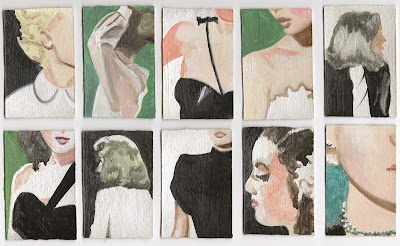
The surface appearance of things is fascinating to me and Hollywood has been the master image maker. Laura Mulvey -in her 1996 essay 'Pandora's Box' said: ‘The cinema has enhanced the image of female seductiveness as a surface that conceals’
![]() |
| Collect the Set, 2013, acrylic and oil on card, 8x4cm each |
Lots of my recent work has involved the use of shiny surfaces – mirrors, iridescent paint, glass. These decorative surfaces are often trivialised and often associated with women. Gams features a series of femme fatale legs, reflected and re-reflected in mirrors.
| Gams, 2013, mixed media installation. Pictured in 2015 at American Tan |
Iris (Albert Maysles, 2015) is a document about octogenarian Iris Apfel whose has made herself a work of art through the way she dresses. She says: ‘with me its not intellectual, its all gut.’
![]() |
| Iris Apfel |
Iris was reviewed on Radio 4's Saturday Review on 1 August 2015 and the three reviewers did not rate it very highly. Sebastian Faulks demeaned Iris and her radical fashion saying: ‘Basically this is a film about a very old woman who spends her life wearing very brightly coloured clothes and bangles… the disappointment is that despite her lovely voice she really doesn’t have anything interesting to say.’ Robert Hanks added: ‘Any film that is about fashion and doesn’t mention the fact that you are exploiting young girls and obsessed with youth and money is telling a kind of lie… I kept thinking it was going to be about something more – immigration, age – but it didn’t turn out to be about any of these things.’ This is because the film was about a woman who had spent her life immersed in dressing her body and the film was admirable because this is exactly what it focussed on.
![]() |
| Wall of mirrors and portraits installed at American Tan |
In American Tan I have installed a wall of mirrors and found portraits. The picture mirrors particularly interest me - they reflect the person looking into them over an image of a star so they blend the self with the object of desire. They are pretty ineffectual as useful mirrors - they are purely decorative. Mirrors are symbols of self obsession - just as fashion is on one level about self obsession – the self as art object. The mirrors have a kitsch association.
The Menil Collection in Houston, Texas, is one of those amazingly vast private collections put together by a rich family with a philanthropic idea of educating people. The Byzantine Fresco Chapel – a modern concrete building designed by the Menil’s architect son, was built in 1997 to house a rescued Byzantine fresco from Cyprus. Sadly for them the fresco had to be returned to Cyprus in 2012 and the structure lay empty. It is now however being used to show contemporary art. The current exhibit is Janet Cardiff & George Bures Miller’s The Infinity Machine. A rotating mobile made up of 150 found mirrors in a dark space accompanied by a space soundtrack. Reflecting each other ad infinitum the artists talk about the generations of people that have been reflected in the mirrored. They are elevated from functional, or vanity objects into poignant signifiers.
![]() |
| Janet Cardiff & George Bures Miller, The Infinity Machine |
It occurs to me that we are all constrained/subject to fashion to some extent – even the style we decide to paint in – we are subject to the power of advertising / marketing / fashion.
Mad Men is one of my favourite TV series – It is beautiful, stylish and seductive but features all the cutting terribleness of America’s mid-century and continuing problems – racism, sexism, corruption etc alongside the power of advertising with its ability to sell us anything.
![]() |
| Mad Men |
I like many others have been seduced by an idea of America drawn in by marketing, cinema, popular culture etc. To accompany America Tan I wanted to show some of the beauty and power of this with a series of Dream America films that cover the last eight decades.
![]() |
| Dream America |
I am showing a different film each day of the show and today’s film has been Roustabout (Rich, 1964) and I will end with a brief paragraph from the screen notes I have put together for the films.
Roustabout
Elvis’ film contract stipulated that he, rather than a stunt double, must be allowed to ride motorbikes and drive cars in his films. In Roustabout he goes down the Wild One (Benedek, 1953), motorbike route. Misunderstood and disaffected he runs into Barabara Stanwyck and ends up romancing her stepdaughter and saving the carnival by singing.
[1] Richard Dyer, Heavenly Bodies (Routledge, 2003) pg 5
[2] Fred Lawrence Guiles, Norma Jeane: The Life and Death of Marilyn Monroe (Granada, 1985)
[3] Richard Dyer, ‘White’, The Matter of Images (Routledge, 2002) pg 145-146
[3] Richard Dyer, ‘White’, The Matter of Images (Routledge, 2002) pg 145-146
[4] ibid
[5] Jodi Hauptmann, Joseph Cornell: Stargazing in the Cinema (Yale Publications in the History of Art 1999), pg 5
There are images and more information from the American Tan show on the Dolph site
[5] Jodi Hauptmann, Joseph Cornell: Stargazing in the Cinema (Yale Publications in the History of Art 1999), pg 5
There are images and more information from the American Tan show on the Dolph site
Tuesday, June 16, 2015
Blue is the colour
Tuymans, Donachie et al. talk about painting light, drawing shadows and work that surprises at the Drawing Room and Turps Gallery
The Drawing Room’s three-person exhibition, DE.FI.CIEN.CY is built around the work
of the long dead and fashionably obscure Andrzej Wróblewski. But of course most
visitors will be there for the star of the show - Luc Tuymans.
Over at the Turps Gallery the inaugural show, Tutti Frutti, featured the work of 14
painters. Any connections between the artists, apart from a shared interest in
paint, are pretty much accidental because they were independently selected by
three artist/organisers, without a theme in mind aside from that suggested by
the show’s title which literally translates as ‘all the fruits’.
I went to artists’ talks at both of these non-commercial spaces
and it set me thinking about galleries that concentrate on individual media and
the practitioners that are loyal to the spaces.
At DE.FI.CIEN.CY Tuymans
in conversation with the show’s curator, Ulrich Loock told us that if there was
a book to go with the show, which also features the work of Rene Daniels
alongside Tuymans and Wróblewski, it would be Raymond Chandler’s Long Goodbye – a fitting choice as the
show has the noirish atmosphere that seems to epitomise Tuymans oeuvre. Tuymans was mostly his taciturn self
only becoming illuminated when he talked about popular references such as his
drawing of a flying monkey from The
Wizard of Oz. One of the more interesting discussions was about blue, a preeminent
colour in the work of another Tuymans favourite, fellow Belgian, Léon
Spilliaert. Loock encouraged Tuymans to explain his own connection to a colour,
which could be seen as another manifestation of his downbeat Belgian ness.
Tuymans explained that when he was young he could only paint in his studio at
night and the yellowish artificial light meant that his work generally had a
bluish tinge to balance the colour.
![]() |
|
Luc Tuymans, Nikko, 2014, watercolour on paper, 29x42cm,
private collection, courtesy of Studio Luc Tuymans
|
And what about drawing? It has, says Tuymans, a sense of
decisiveness because unlike painting it cannot be changed and subsequently the
painted line has a very different quality to the drawn line. Because of these
differences Tuymans prefers to exhibit drawing separately from painting, unlike
other artists (such as he somewhat disapprovingly noted Marlene Dumas), who are
happy to mix them up. My struggle with this magnanimous idea about drawing and
painting is that to all extents and purposes the drawings on show in DE.FI.CIEN.CY are, as far as I can see,
only drawings because they are on paper. They are mostly made with paint. But
maybe this is a minor detail. Other little nuggets of Tuymans info that I
gleaned were that he considers the Arnolfini
Portrait the first conceptual painting and that shadows are very hard to
paint because they are non-colours.
And so onto the Turps gallery, the latest addition to the
Turps Banana empire, which recently opened in a defunct South London estate
alongside the Turps Art School. Marcus Cope led a discussion with a number of
the Tutti Frutti artists, co
organiser Katrina Blannin
and an engaged audience of painters.
![]() |
| Painters talking at Turps Gallery L to R: Daniel Sturgis, Kaye Donachie, Katrina Blanin, Katrin Maurich, Nick Goss, Marcus Coates, Unknown Nick Goss's work can be seen behind Marcus Coates |
Kaye Donachie, best known for loosely painted depictions of
women, talked about her Tutti Frutti work
which rather than a painting is a cyanotype on canvas. A cyanotype is a basic
photographic process using a light sensitive chemical, the resulting image, as
suggested by the name, is always blue. Donachie’s desire to ‘paint with light’ led
her to the process and the resulting work has, it was noted, the quality of an animation.
One audience member wondered if the resulting image always had to be blue – the
answer I think is in the name. Printing it seems is very much in vogue with
painters. Nick Goss had also included printed sections in his large work, which
was inspired by glimpses into the Turkish Sports Clubs around his Green Lane’s
studio. His and Donachie’s mix of figuration and abstraction is very prevalent
in contemporary painting – and maybe this desire to get away from a too literal
reality while retaining some of its structure explains their experiments in print
making.
Artist Erin Lawlor said that too much intention kills her
gestural abstract works and that she was always waiting for the work to
‘surprise’ her. Many painters believe in the power of happenstance which explains why they
so often struggle with concept driven mainstream art education, which can seem
to kill the spontaneity that is thought to be so important to
‘good’ painting. It is certainly true that the creative process involved in
painting is hard to quantify and for this reason it does seem to be at odds
with much of the cerebral art world. Katrin Mäurich knows when one of her individually
shaped wooden paintings is finished because it ‘looks like a little dance’.
This esoteric, vague language has made painting an art school outsider. Which
is why the Turps School is thriving. It has stepped in, knight in shining
armour to save painting. But in reality state art education should be
addressing painting in a more satisfying way and students should not have to resort
to independent art education. I am not calling the ethos of the Turps School
into question here but there will no doubt be other less scrupulous
establishments opening up that rip off less knowing artists. We should all be
campaigning against cuts in art education, as Bob and Roberta Smith are so
commendably doing, or art as a whole will become a marginal activity.
The Turps Gallery, we were told by Katrina Blannin, is there to fulfil a
need that is unaddressed by other galleries – it is a place for painters to put
together painting shows. I have reservations about limiting a gallery to one
specialism, but it seems that there are plenty of takers for this form of
exhibiting. The Turps Gallery grand opening attracted over 400 people to the
modestly sized space, so separating painting from the rest of the artworld is
obviously popular, but could it also be dangerous? Not giving painting the
chance to connect with other media and taking it away from the conceptual,
could well result in the confirmation that painting is the irrelevant and
reactionary medium that so many art school tutors have told us that it is. I
for one want to stay connected to ideas and don’t want to be painted (or drawn)
into a corner.
DE.FI.CIEN.CY
Rene Daniels, Luc Tuymans, Andrzej Wróblewski
curated by Ulrich Loock
21 May – 11 July 2015
TheDrawing Room, London
Luc
Tuymans was in conversation with Ulrich Loock was on 21 May 2015
Tutti Frutti
Carla Busuttil, Graham Crowley, Kaye Donachie, Tim Ellis, Nick Goss, John Greenwood, Erin Lawlor, George Little, Katrin
Mäurich, Charley Peters, Audrey Reynolds, Daniel Sturgis, Richard Wathen, James White
organised
by Katrina Blannin, Juan Bolivar & Caterina Lewis.
24 April
– 24 May 2015
Turps Gallery, London
Tutti Frutti artists' talk was on 24 May 2015


